Engineering plastics require different recycling methods
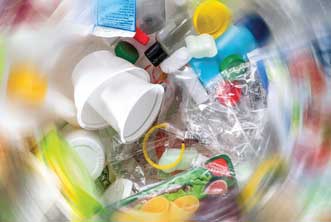
In order to recycle a wide range of plastics, various recycling technologies are necessary. While plastics for mass applications, such as polyolefins for packaging, can often be recycled using established processes, specialty plastics often require recycling solutions tailored to their specific properties and applications. This applies, for example, to plastic mixtures that contain numerous additives such as additives or dyes in addition to polyolefins, PUs or PAs.
These materials are developed for demanding applications, such as the automotive sector, where standard plastics often do not meet the required performance characteristics. This is what German chemical firm BASF’s researchers have concluded in an article published in the US journal Accounts of Materials Research.
In order to keep plastics from heterogeneous waste streams in the cycle, two prerequisites are crucial: efficient sorting processes on an industrial scale and a wide range of recycling technologies. Which recycling solution is suitable depends on both the material and the composition of the waste stream.
"There is no one standard technology for recycling engineering plastics," emphasised first author Dr. Bernhard von Vacano, head of the Plastics Circularity research program at BASF. "Rather, an intelligent mix of different, complementary technologies that match the respective plastic waste is decisive. The goal is to produce high-quality recycled materials and to keep engineering plastics in the cycle permanently."
Mechanical recycling is the most widespread: plastics are sorted, shredded and melted down. This process is energy-efficient, but does not work with all plastics and only for clean and sorted waste. Mechanical recycling is particularly suitable for packaging waste, which produces large quantities of relatively homogeneous plastics with only a few additives. However, high quality and hygiene requirements can limit the use of mechanically recycled materials in new packaging. In the case of plastics for technically demanding applications, mechanical recycling often reaches its limits, as suitable waste streams are often only available to a limited extent and the products usually consist of complex polymer compositions.
In contrast, solvent-based recycling is suitable for more complex plastic waste. In this process, a special type of plastic is selectively dissolved with a solvent, separated and purified. For example, polyamides can be recovered from vehicle scrap and processed into components again.
Another important recycling technology is depolymerisation. Here, plastics are broken down into their basic building blocks and reassembled. With loopamid, BASF researchers have developed an innovative process that enables the circular textile-totextile recycling of PA6. As a result, PA fibres can be produced from textile waste thatare just as high quality as conventional polyamide 6. At the beginning of 2025, BASF commissioned the first commercial loopamide production plant at its Caojing site in Shanghai, China.
Plastics from highly mixed waste, which so far have mainly ended up in waste incineration, can be recovered in thermochemical processes such as pyrolysis and gasification. These technologies require a lot of energy. In pyrolysis, the long-chain polymers of the plastics break down into short hydrocarbon chains, which can be reused as a raw material as pyrolysis oil. Gasification produces syngas, which serves as a chemical starting material in production.
Numerous pilot projects by BASF show that many recycling processes for PUs and PAs work technically and that raw materials in virgin quality can be recovered from plastic waste.
"However, we are still missing two crucial building blocks so that we can use these technologies on an industrial scale and enable viable business models for large investments: On the one hand, we need a suitable waste management system so that we can keep the plastics in the cycle in the long term. In addition, policymakers must establish clear and reliable framework conditions for recycling," said Dr. Jens Hamprecht, co-author of the publication and Vice President of BASF's Performance Materials division.
(PRA)SUBSCRIBE to Get the Latest Updates from PRA Click Here»