Medical Technology Sector: Medical care gains an edge in next generation technologies
Healthcare demands are becoming more challenging, requiring more sophisticated therapies. Balancing this with higher patient compliance and better outcomes remains a work in progress that medical technology manufacturers continue to address, says Angelica Buan in this report.
Rise of value-based healthcare Over-complex innovation does not cut it in medical technology. This is because the demand now is patient-centric, gravitating towards patient benefit, societal affordability, as well as manufacturer returns. That said, it behooves both manufacturers and healthcare systems to advance medical technology because doing so generates a shared, reinforcing cycle: better technology improves patient outcomes and system efficiency, which generates market demand and reimbursement, which in turn funds further innovation.
Continuous innovation backs the growth of the global medical device manufacturing market, which is projected to cross US$153 billion by 2034 from US$92 billion in 2026, representing a CAGR of 6.5% over the forecast period, according to Fortune Business Insights.
Currently, there are certain expectations that advanced devices must meet, such as enabling earlier and more accurate diagnosis, less invasive treatments, and better long-term disease management. They must also provide justifiable costs, shorten hospital stays, reduce procedure complexity, and enable more care to be provided in outpatient rather than inpatient settings.
At the same time, advanced materials such as thermoplastic elastomers (TPE), silicones, and high-performance medical plastics matter to value-based healthcare because they directly affect the three pillars that define “value”: quality of outcomes, cost of care, and equity of access. Put simply, better materials enable better, more affordable, and more widely available devices, which is exactly what value-based care demands.
TPEs in critical devices
For emergency equipment such as automated external defibrillators (AEDs), materials must combine durability with flexibility, insulation and a secure grip. Germany-based TPE manufacturer Kraiburg TPE's Thermolast H compounds are designed for healthcare applications and can be used in AED grips, cables, seals and protective housings.
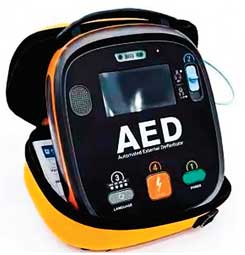
The medical TPE compounds meet ISO 10993-5 and GB/T 16886.5 cytotoxicity standards, as well as Regulation (EU) No 10/2011 and US FDA CFR 21 raw material requirements. They can also be sterilised through autoclave processes at 121°C and ethylene oxide treatment, and are free from animal-derived ingredients, heavy metals and toxic substances.
The compound’s ability to bond with engineering plastics such as PC, ABS, PC/ABS, ASA, SAN, PET, PETG and PS gives manufacturers more options when producing integrated components. The materials can be injection moulded or extruded into switches, seals, membranes and flexible connections, while their soft-touch surface is suited to grips and other parts that need comfortable handling.
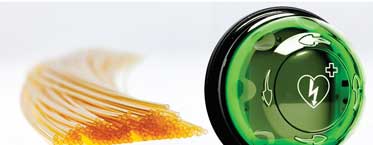
Similarly, chemical producer Saudi Basic Industries Corporation (Sabic) offers its latest medical-grade TPE such as the Ultem HU resins and Siltem HU copolymers as fluoropolymer alternatives for selected medical tubing applications. Its portfolio also includes LNP Elcres NPCRX9612U resin, certified under UL746G as nonPFAS for device housings, and LNP Lubriloy compounds formulated without PTFE for wear and friction parts.
Other Sabic materials target the physical demands of equipment. LNP Elcres CRX copolymer resins provide chemical resistance for equipment and device housings, while LNP SLX grades offer impact and UV resistance, including use in the transparent cover of a Rotaid AED cabinet. Ultem HU resins are also used for surgical robot wrist and arm-base components, where lightweight strength and compatibility with sterilisation methods are required.

German materials producer BASF is also applying different polymer properties to medical and safety equipment. Its Ultrason P 3010 BMB is a biomass-balanced PPSU containing 20% attributed bio-circular feedstock while retaining the same chemical identity, processing characteristics and certificates as its standard counterpart. The material offers high-temperature stability, chemical resistance, toughness and long-term durability for applications including medical devices.
Another BASF material, Ultramid A3XZC3 ESD, shows how a polymer can be formulated for a very different need. The highly impact-modified, carbon fibre-reinforced material is used for the backplate of MSA's M1 self-contained breathing apparatus. It combines flame retardancy, mechanical strength and reduced surface resistivity. The assembled breathing apparatus passed an independent flame test while retaining full operational function, and its handle can withstand emergency loads of up to 200 kg. In explosion-hazard areas, its reduced surface resistivity also lowers electrostatic charging and the risk of spark formation.
Meanwhile, Belgian materials company Syensqo provides another example of how polymers can be used in implantable devices. Its medical-grade TPEs include Radel PPSU and Udel PSU, while its Solviva biomaterials portfolio includes Zeniva PEEK, Eviva PSU and Veriva PPSU. These materials are used in medical equipment and long-term implantable devices, with properties suited to applications requiring durability, strength, sterilisation resistance and lightweight, radiolucent designs.
Silicone for fluid management
Similarly, silicone materials are gaining prominence in more sophisticated operations. For example, fluid management presents a different material challenge because tubing must remain flexible while maintaining consistent flow during repeated use.
US healthcare company TekniPlex Healthcare’s medical silicone tubing is designed for peristaltic pumps, infusion pumps and other medical fluid management devices, where elasticity, fatigue resistance and long-term performance stability are required.
Silicone is also used in more specialised tubing configurations. TekniPlex's Para-tubing solutions are designed for ophthalmic minimally invasive surgical devices, where several independent tubing lines may need to fit within a compact space. The design allows separate fluid and gas lines to be arranged in multi-row configurations while maintaining consistent quality.
For vascular procedures, TekniPlex also produces PTA/ PTCA precision interventional tubing, including single-layer and multi-layer balloon catheter tubing and three-layer inner tubing. These products require low friction, bondability, dimensional control and trackability, together with accurate dimensions, concentricity and consistent manufacturing.
(PRA)SUBSCRIBE to Get the Latest Updates from PRA Click Here»