Green news: Evonik/Toyotsu Chemiplas/Sanyo Chemical launch PU recycling in Japan; Toray develops tech to recover PPS from waste materials
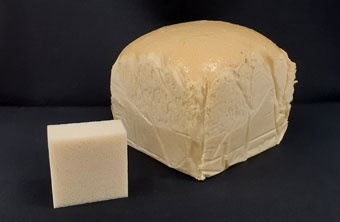
German chemical firm Evonik has partnered with Toyotsu Chemiplas Corporation and Sanyo Chemical Industries to develop a recycling model for polyurethane (PU) foam in Japan for Japan. The partners aim to convert discarded foam into recycled polyols and amines for use in new PU products. The initiative forms part of Evonik’s wider efforts to scale PU recycling through collaboration across the value chain.
PU foam is widely used in everyday products, including automotive seats, mattresses, and furniture. However, used foam is frequently incinerated or sent to landfill, while conventional mechanical recycling generally restricts its use to lower-value applications. Chemical recycling offers the potential to recover important raw materials, such as polyols and amines, and thereby help close the loop in flexible polyurethane foam production.
Within the partnership, Toyotsu Chemiplas will coordinate the initiative and contribute its collection network and logistics expertise. Sanyo Chemical will provide its expertise in polyol development and process technology, while Evonik will contribute its proprietary hydrolysis-based chemical recycling process and technical expertise.
The partners plan to develop a system for collecting both post-consumer PU foam and post-industrial scrap. The collected material will be chemically recycled into high-purity polyols and amines, intended for reuse as raw materials in the manufacture of new PU products.
The hydrolysis-based chemical recycling process from Evonik is designed to produce recycled polyols with high purity and consistent quality. The process provides PU foam manufacturers with a drop-in solution and can significantly reduce carbon footprint compared to virgin materials. New PU foam has already been successfully produced using 100 percent recycled polyol derived from the process.
The three companies will jointly evaluate the entire process, from collection and sorting to the production of recycled polyols and the manufacture of new PU products. This work will include quality assessments and further updates to Evonik’s existing life cycle assessment to reflect the proposed value chain in Japan. The objective is to commercialiSe the technology and establish a scalable recycling model for PU foam in Japan.
Toyotsu Chemiplas is responsible for coordinating the initiative and will contribute its collection network and logistics expertise. Sanyo Chemical will contribute its expertise in polyol development and process technology. Evonik will provide its hydrolysis chemical recycling technology and technical expertise as part of its global efforts to support the scale-up of polyurethane recycling through partnerships.
In other news, Toray Industries has announced that it has developed what it believes is, as of the publication of this release, the industry’s first solvent-based recycling technology to recover polyphenylene sulphide (PPS) from waste materials.
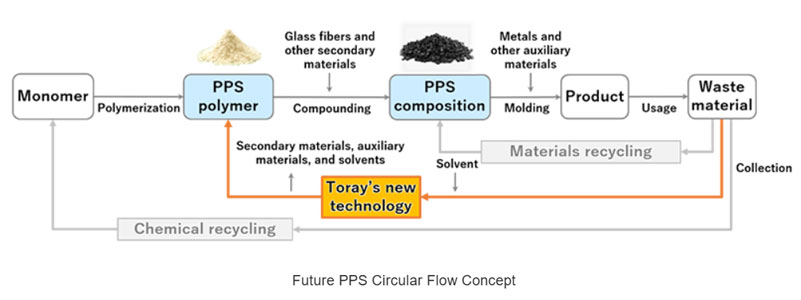
The technology selectively dissolves and separates PPS from the materials while retaining its polymer form instead of breaking it down into a monomer. Because this process does not require such decomposition, it removes impurities more efficiently than conventional chemical recycling processes.
PPS is a super-engineering plastic with excellent heat and chemical resistance. Demand for it is growing, particularly for automotive parts and electrical and electronic components. Recovering usable PPS from end-of-life products has been difficult because contaminants are hard to remove and because there have been no effective recycling processes to date. At the same time, stricter resource circulation regulations, particularly in Europe, are increasing the importance of post-consumer recycling the automotive and other industries.
Virtually no solvents can dissolve PPS because of its high chemical resistance. Toray overcame this challenge by leveraging decades of PPS manufacturing technology to selectively dissolve and crystallize PPS from waste materials and remove glass fibres and other impurities. The resulting recycled material maintains the same molecular weight and melting point as virgin PPS.
A preliminary Toray study suggests that recycled PPS made with this technology may reduce cradle-to-gate greenhouse gas emissions compared with the company’s PPS made from virgin materials. Toray is currently verifying these potential reductions through ongoing demonstration testing.
The company aims to start commercial supply in around 2030. It will work with partners in the automotive, recycling, and other industries to establish a resource circulation system spanning the collection of PPS-containing waste materials through the reuse of recycled PPS.
(PRA)SUBSCRIBE to Get the Latest Updates from PRA Click Here»