Recycling: Covestro/Fraunhofer UMSICHT tie-up for pyrolysis pilot plant; Lego surpasses 50% recycled content in products
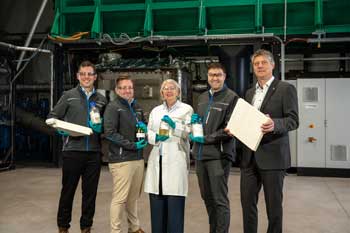
Materials manufacturer Covestro and the Fraunhofer Institute for Environmental, Safety and Energy Technology UMSICHT have signed a contract to operate a 2 kilotonnes/year pilot plant for smart pyrolysis of rigid polyurethane foam waste. The plant will be operational by 2028.
The agreement marks a significant milestone in scaling up the technology to convert insulation waste from appliance and construction into high-purity re-aniline for the production of MDI (methylene diphenyl diisocyanate). The resulting MDI meets the same purity standards as conventional MDI with up to 40% lower carbon footprint compared to conventional fossil-based production routes.
Under the agreement, Fraunhofer UMSICHT will draw on its pyrolysis research expertise and existing chemical recycling infrastructure to implement and scale up Covestro's proprietary smart pyrolysis process.
The resulting amount of aniline could be used to produce insulation for roughly 200,000 refrigerators . The new plant is scheduled to begin operations in mid-2028 and will process rigid PU/PIR foam waste primarily from end-of-life insulation PU materials. The technology specifically targets rigid foam because it is notoriously difficult to recycle due to its crosslinked molecular structure.
The smart pyrolysis process yields aniline with approximately 99% purity, suitable for producing recycled MDI that meets the same quality standards as conventional MDI.
This development is particularly important as the MDI market for rigid foam is projected to grow from 1,400 kilotonnes in 2025 to 1,900 kilotonnes in 2035 in Europe alone, driven by increasing demand for energy-efficient insulation in buildings and refrigeration. EU regulations and market requirements, for example, increasingly request scalable end-of-life solutions for PU/PIR rigid foam, posing a significant challenge for the industry.
The chemical recycling technology developed by Covestro and Fraunhofer UMSICHT offers a viable path forward by breaking molecular bonds to recover valuable raw materials that would otherwise be lost.
The technological development builds on extensive research within Circular Foam, an EU-funded flagship project coordinated by Covestro with Fraunhofer UMSICHT and 23 other partners across Europe. After successful laboratory and mini-plant scale demonstrations, the smart pyrolysis pilot plant represents the critical next step toward commercial implementation.
Meanwhile in other news, Danish toy maker Lego has reported that 52% of the materials used to produce its bricks in 2025 came from renewable and recycled sources, up from 33% in 2024.
The milestone forms part of the company’s broader sustainability roadmap, which targets more sustainable product materials by 2032 and net zero emissions across its value chain by 2050.
The update was released alongside Lego’s 2025 Sustainability Statement, which also reaffirmed its goal to reduce carbon emissions by 37% by 2032 compared to a 2019 baseline.
A significant portion of Lego’s renewable and recycled input is sourced through a mass balance approach. Under this system, suppliers blend virgin fossil materials with certified renewable or recycled feedstocks such as used cooking oil or plant-based inputs. Lego purchases certified volumes, with documentation verifying the renewable share.
In 2025, 60% of Lego’s purchased materials were sourced via mass balance, up from 47% in 2024. An additional 4% of materials were directly sourced sustainable inputs, bringing the estimated average renewable and recycled content to 52%.
The company noted that despite 29% revenue growth since 2022, it used less virgin fossil-based material in 2025 than it did three years earlier, indicating decoupling of growth from fossil-based material use.
The company is also phasing out single-use plastic packaging in Lego boxes. As of 2025, 56% of global factory packaging lines have transitioned to paper-based bags.
(PRA)SUBSCRIBE to Get the Latest Updates from PRA Click Here»