Expansions: Nextchem to undertake feasibility studies for recycling plants in Southern Africa/Southeast Asia; Econic/Changhua start up CO2-based polyols plant in China

Italy’s Maire has announced that its subsidiary Nextchem has been awarded two feasibility studies in Southern Africa and Southeast Asia dedicated to mechanical upcycling and compounding plants based on its NXReplast proprietary technology. The projects aim to valorise post‑consumer and post-industrial polyolefin end-of-life materials, into high-quality compounded r-polymers, with technical properties equal to virgin equivalent.
The project in Southern Africa aims to process around 25 kilo-tonnes/year of post-consumer and post-industrial polyolefin end-of-life materials into high-quality compounded r-polymers and is being developed by a major local industrial player. It represents one of the first circular initiatives in the region, leading the efforts to promote resource efficiency and the use of sustainable materials in a cost-effective way. Nextchem’s feasibility study will cover process configuration, cost evaluation, and preliminary engineering works.
In addition, Nextchem has been selected by a leading Southeast Asian operator to develop a feasibility study for a 40 kilotonnes/year mechanical upcycling and compounding plant based on the same NX Replast technology.
Fabio Fritelli, Managing Director of Nextchem, commented: “These new awards confirm the global reach of our circular technology offering. They also demonstrate how our technological platform is increasingly selected as a reliable, competitive, and scalable solution for advanced plastic upcycling also in new markets, supporting international partners in shaping high impact sustainability roadmaps through proven engineering capabilities and cost-efficient solutions.”
In other news, renewable materials firm Econic Technologies has announced that its partner Changhua Chemical has opened the world’s first commercial-scale production site for polycarbonate ether (PCE) polyols, a new class of sustainable polyols made with carbon dioxide. Branded as Carnol, the new polyols are based on a proprietary technology from Econic that results in cost-competitive, high-performing products with a 30% lower carbon footprint versus typical polyols.
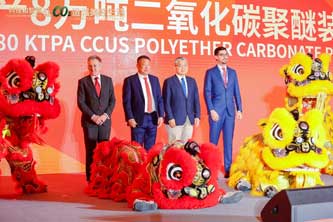
The new site is located in Lianyungang in China’s Jiangsu province. It will produce about 80,000 tonnes of Carnol in 2026 with plans to scale to more than 1 million tonnes in years to come.
Carnol polyols are designed for use in polyurethane foams, coatings, elastomers, and other applications in which they offer both environmental benefits and improved performance. For example, flexible foams made with Carnol have a lower carbon footprint as well as enhanced load bearing and tensile strength characteristics versus industry benchmarks. Other examples of applications include lightweight automotive parts, protective apparel and footwear, and insulating construction materials.
“The opening of this plant is a watershed moment for the chemical industry. It demonstrates the industrial readiness of captured carbon utilisation. Now brand owners and manufacturers across the whole value chain can reduce their carbon footprint by using captured CO2 as a sustainable raw material. Together with Changhua Chemical we are creating value from something that was once waste and paving the way for broad adoption of this technology in the polyurethanes market and beyond,” said Keith Wiggins, CEO of Econic Technologies.
Outside of China, Econic’s polyols technology is licensed by Monument Chemical in the US. The company has announced MOUs with Manali Petrochemicals in India, Sanyo Chemical in Japan, PTT Global Chemical Public Company Limited in Thailand, and Chimcomplex in Romania.
In 2025, it also expanded its portfolio of technologies into surfactants with the launch of Recreaire carbonate ethoxylates.
(PRA)SUBSCRIBE to Get the Latest Updates from PRA Click Here»