Packaging to suit needs and requirements
Sustainable compression packaging
In response to consumer preferences and brand owner commitments, many converters are facing the challenge of developing hygiene compression packaging films with sustainability benefits such as downgauging, incorporation of recycled content, and design for recyclability.

In response, ExxonMobil Signature Polymers’s team worked across the value chain to develop two monomaterial PE film solutions with reduced thickness and/or the incorporation of up to 35% PCR content. The films were produced at an ExxonMobil facility, converted on Hudson-Sharp’s Apollo wicket machine, and formed and sealed using Optima’s machinery.
In ExxonMobil’s formulation, the use of Exceed Tough+ m 0518 helps enhance the production of films with remarkable toughness and puncture resistance. When combined with ExxonMobil HD 6207FL polymers, it results in high stiffness and creep resistance, ensuring that the package maintains its dimensional stability throughout and after the packaging process.
Minor additions of ExxonMobil LD 07523 polymers can be employed to adjust processability and optical features. By leveraging just three PE grades, it is possible to reduce the film thickness and/or incorporate up to 35% PCR content while still meeting performance and processability requirements.
The films were made on lines located in an ExxonMobil facility. The films were then converted on HudsonSharp’s Apollo wicket machine, that is ideally suited for monomaterial PE films, which may or may not incorporate recycled content, even at very thin gauges. Thanks to the excellent sealability and easy side cutting/punching provided by ExxonMobil’s two PE film formulations, high machine output can be achieved. Customers can continue to benefit from fast changeovers, while achieving high output speeds, it adds.
The package was subsequently formed and sealed using Optima’s machinery, which is specifically calibrated to handle these materials while ensuring optimal performance and quality, exhibiting sufficient stiffness to prevent film elongation during handling and a good coefficient of friction for the grippers. These attributes are essential for maintaining the shape and functionality of the package, helping the products to be securely contained.
Creating cost-effective vacuum-skin packaging
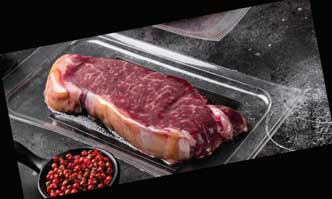
Traditional ionomer-based vacuum packaging can be easily impacted by ionomer material shortage, hence be expensive to produce. Three companies leveraged their expertise across the value chain to produce an ionomerfree vacuum skin packaging that is both cost effective and provides high performance attributes.
ExxonMobil developed a formulation using its Exceed Flow+ and Exceed Tough+ performance PE in combination with its ExxonMobil EVA resin and materials maker Kuraray’s barrier material, Eval T101B. The formulation was used to produce blown film by Italian extrusion machinery maker GAP.
To demonstrate the high performance and excellent shelf appeal, G.Mondini, an Italian processor of packaging food, provided access to its vacuum-skin packaging line, for vacuum and full seal around the product.
This work across the value chain brought a cost-effective solution to the market by reducing dependency on ionomers.
The ionomer-free solution using Exceed Flow+ and Exceed Tough+ and ExxonMobil EVA polymer grades delivers shelf appeal, toughness properties such as tear and puncture. It brings an outstanding gloss of 81, and transparency (haze 7.5%).
Videplast creates downgauged, mono-material PE pet food packaging
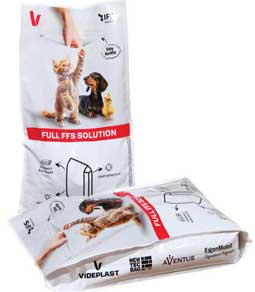
Brazilian converter Videplast was looking to provide its customers a competitive advantage in performance and cost. Their challenge was to create pet food packaging that maintains stiffness and toughness in a mono-material solution at a lower gauge and with cost savings opportunities.
The solution would be compared to a mono-material solution at a thicker gauge used to replace PET-based solutions.
Part of the challenge the company faced was embracing was achieving mechanical properties, printability and aesthetics that match PET-based solutions at lower gauges. PET provides excellent stiffness and dimensional stability, while PE is softer and more flexible, which can affect packaging integrity and machinability. PET has a smooth surface ideal for high-quality printing whereas PE may require surface treatments (e.g., corona treatment) to achieve similar print quality.
The development of the new form, fill and seal (FFS) film was carried out through a strategic partnership between Videplast, Haver & Boecker and ExxonMobil.
After defining the optimal material architecture, advanced laboratory tests were conducted to validate the performance of the selected resins (Exceed Stiff+ m 0926 for stiffness/ toughness balance and Exceed Stiff+ m 0238 for stiffness and processability).
In the extrusion stage, the structure was produced via multilayer co-extrusion using PE, ensuring thickness uniformity, operational stability, and processability, even with material reduction.
Next, the film underwent flexographic printing, fully leveraging the surface properties of the resins to achieve superior ink adhesion and premium visual quality. Finally, lamination, alignment, and precision rewinding steps ensured mechanical strength, print protection, and dimensional accuracy, resulting in FFS rolls ready for use in automatic filling and sealing lines.
The use of ExxonMobil Signature Polymers was a key enabler to reduce the thickness of the FFS film from 180µm to 160µm while maintaining the performance levels demanded by the market.
This optimisation delivered direct economic benefits through lower raw material usage, and increased productivity. The new configuration made the solution more competitive in cost-sensitive markets and more attractive to customers.
(PRA)SUBSCRIBE to Get the Latest Updates from PRA Click Here»