Bio-based polyesters and foams open up possibilities
New findings from the Fraunhofer Cluster of Excellence Circular Plastics Economy CCPE show how commercial PBSA (polybutylene succinate-co-adipate)/PLA (polylactic acid) blends can be specifically tailored through industrial processing methods to make them suitable for flexible film applications. This opens up concrete bio-based alternatives.
The study demonstrates a clear correlation between processing, microstructure, and mechanical behaviour. Both cast films and blown films exhibit a lamellar blend morphology at the microscale but differ on the nanoscale. In cast films, processing leads to an orientation of the semi-crystalline PBSA structures, whereas no comparable crystalline preferred orientation is observed in blown films. The two film types examined thus cover a wide range of stiffness and strength and achieve property levels relevant for the substitution of typical polyolefins.
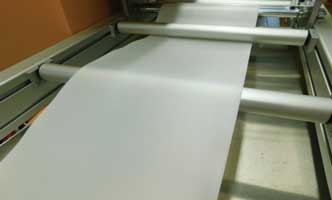
For companies across the value chain – from compounding and film extrusion to packaging development – the results show that the properties of PBSA/PLA blends can be specifically tailored for material and process development.
This makes it possible to evaluate the substitution potential relative to established materials such as HDPE.
Since processing took place on industry-standard equipment, the findings are directly transferable to realworld production conditions and provide a robust basis for development decisions.
Meanwhile, Fraunhofer LBF and Fraunhofer IAP are seeking collaboration with companies and partners who wish to make direct use of the published results.
Bio-based foam an alternative to PE foam
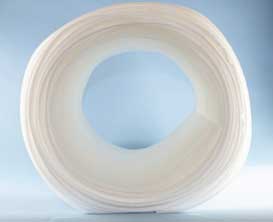
In another study, CCPE offers an extruded foam made from PBS, developed without the need to invest in new equipment. This approach simultaneously addresses CO2 reduction, compliance with regulatory requirements, and economic efficiency, it adds.
Thanks to its unique properties, it can replace conventional PE foams in key applications – such as packaging, protective and transport solutions, and construction applications. In these high-volume markets in particular, regulatory requirements and increasing sustainability demands are driving the need for bio-based materials.
A key factor for industry is that xPBS functions as a so-called drop-in solution. The foam can be processed on existing extrusion lines without requiring major investments in retrofitting. This gives companies the opportunity to make their products more sustainable in the short term without fundamentally changing existing processes.
The project’s success is based on close collaboration among several Fraunhofer CCPE institutes and their expertise across the entire value chain. While Fraunhofer ICT drove the formulation and process development of the foaming process as well as the upscaling to pilot-scale plants, Fraunhofer IAP focused on polymer synthesis and the targeted adjustment of material properties.
The developed PBS foams achieve densities on par with established LDPE materials and can be processed reliably.
At the same time, the material offers significant environmental benefits: PBS is bio-based, biodegradable, and can be recycled due to its thermoplastic nature. For companies, this means they can achieve their sustainability goals without having to compromise on technical performance.
With the follow-up project xPBS-food, which launched in January 2026, the technology is being specifically adapted for the sensitive field of food packaging. The goal of the joint project between the Fraunhofer CCPE Institutes ICT; IAP, LBF, and IVV is to develop a food-safe, PBS-based, monomaterial foam packaging solution that meets functional and sensory requirements while also being recyclable or biodegradable.
(PRA)SUBSCRIBE to Get the Latest Updates from PRA Click Here»