Green news: Lallemand/Braskem launch bio-acetone/ethanol production; Teijin/Fujifilm use recycled PC for printer parts
Canada’s Lallemand Biofuels & Distilled Spirits, specialising in yeast, enzymes, microbials and nutrition, and Brazilian polyolefins maker Braskem have announced a bio-acetone production platform for the corn-ethanol industry that enables producers to generate a new coproduct alongside ethanol. Combining LBDS' proprietary fermentation technology with Braskem's bio-acetone recovery process, the solution creates a new revenue stream for biorefineries while maintaining ethanol production performance and providing access to a guaranteed demand for all bio-acetone produced.
After five years of collaborative development and validation, Braskem and LBDS are now making the technology available to the US ethanol industry. The companies have engineered an innovative yeast strain to enable bio-acetone production during fermentation, without affecting performance.
Braskem developed bolt-on technology to separate the resulting bio-acetone from ethanol and will be responsible for all bio-acetone sales and market development.
Acetone is a mature market with global demand of over 8 million tonnes/year, serving segments that are seeking new solutions from renewable sources.
Bio-acetone is a drop-in replacement for fossil-based acetone and can be used in cosmetics, paints and coatings, acrylics, adhesives, and personal care applications. It is 100% renewable, benzene-free, phenol-free and verifiable through a C14 test.
In other news, Japan’s Teijin Limited announced that it has established a horizontal closed-loop recycling scheme in collaboration with Fujifilm Business Innovation Corp.
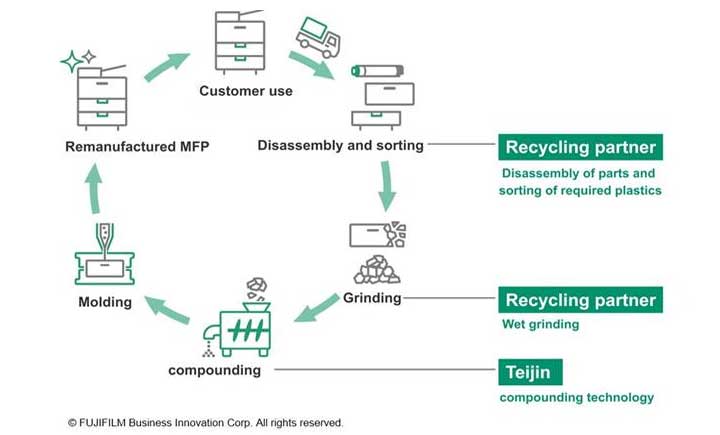
Using recycled plastic derived from the exterior parts including front covers of Fujifilm Business Innovation’s used multifunction printers, Teijin formulates its Multion CM, a family of circular materials combining recycled polycarbonate-based alloy resin. This resin, containing 80% recycled content, is used for the exterior parts of Fujifilm’s remanufactured multifunction printers. Notably, components manufactured under this closed-loop system are suitable for the highly visible covers of multifunction printers.
Post-consumer recycled plastic tends to experience lower physical properties compared with those of virgin materials. To address this challenge, Teijin applies a design-for-recycling concept to its polycarbonate alloy resin Multion, used for exterior parts, and manufacture it by a formulation designed especially to retain its physical properties and appearance while minimising degradation and discolouration after long-term use.
Fujifilm collects its used multifunction devices through its own network, then, in cooperation with recycling partners, removes metals and different types of plastics from the exterior parts before recovering, disassembling and sorting only the desired plastics. A wet grinding process is employed to minimise contamination by foreign substances, enabling the production of recycled material that is used to produce Multion CM.
Teijin applies its proprietary compounding technology related to physical property restoration and colour adjustment to ensure Multion CM, with its high percentage of recycled content, is comparable in quality to virgin material.
Importantly, by combining Fujifilm’s closed-loop resource circulation system with Teijin's proprietary compounding technology, Teijin has achieved colour matching for white shades in Multion CM, which had been difficult to realise with conventional closed-loop mechanical recycling.
In recent years, against a backdrop of increasing instability in resource supplies and rising raw material prices, the importance of efforts to make effective use of limited resources has been growing. In particular, social demand is increasing for the circular use of products and materials, including plastic resources, and companies are being called upon to undertake initiatives that help realize resource circulation throughout the entire product lifecycle, reduce the consumption of exhaustible resources, and reduce waste.
(PRA)SUBSCRIBE to Get the Latest Updates from PRA Click Here»