ExxonMobil Polymers: Sustainability in Packaging
Rising consumer awareness and evolving regulations are driving brand owners to seek packaging solutions that incorporate recycled content. In these case studies, ExxonMobil Signature Polymers worked with machinery makers Reifenhauser and W&H to validate the solutions.
Stretch hood films with 35% household-sourced PCR content
With demand for high-quality post-consumer recycled content (PCR) from industrial and commercial sources expected to rise in the years to come, the industry is being driven to explore the use of lower-quality PCR, such as waste sourced from household streams.
Household-derived PCR streams have traditionally been considered too contaminated for high-performance applications like stretch hood films. Yet, this is exactly where innovations in materials science and process engineering, combined with the right collaborations, can redefine what’s possible.
In collaboration with Reifenhäuser Blown Film, ExxonMobil Signature Polymers developed a high-performance stretch hood film that can incorporate up to 35% PCR derived from household sources. This breakthrough is enabled by Reifenhäuser’s EVO Fusion line, whose twin-screw technology provides the intense shearing, thorough homogenisation, and volatiles extraction required to process lower-quality PCR materials into a high-quality film.
At the core of this innovation are ExxonMobil’s resins. The five-layer film formulation features Exceed Tough+ m 0512 PE for its excellent bubble stability, good openability features, and high holding force, alongside Vistamaxx 6102 performance polymer, which facilitates PCR incorporation by enhancing the film toughness.
The Vistamaxx polymer content was kept ≤ 15% for potential compatibility with design for recyclability guidelines2. The PCR resin (Systalen LD-C12200) provided by Der Grüne Punkt is derived from post-consumer waste collected through Germany’s ‘yellow bag’ recycling system. This PCR fraction is blended with Exceed Tough+ m 0211, a low-MI PE that can act as a gel grinder, further improving film performance and optics.
Friction control is essential for stretch hood applications, yet difficult to achieve with heavily contaminated PCR. Permanent and non-migrating slip additives (such as Constab SL 05077 LD, provided by Constab GER) may ensure a stable and consistent coefficient of friction throughout processing and usage.
Reifenhäuser’s twin-screw extruder technology ensures thorough mixing and homogenisation of PCR blended into virgin resin(s). Its shear action effectively breaks down gels and distributes them evenly, minimising the risk of film failure during the stretch hood application. Additionally, the EVO Fusion line is equipped with an in-line degassing system that effectively removes volatiles (which tend to be particularly prevalent in household-sourced PCR), ensuring a bubble-free film that is capable of withstanding the high mechanical stresses of industrial packaging.
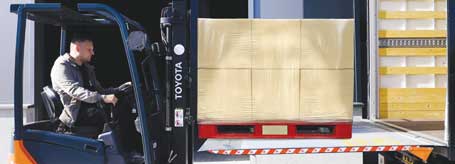
The film was tested on the Lachenmeier hooding system, where it was evaluated against key performance metrics including friction control, tear resistance, and load retention. Despite the incorporation of lower-quality PCR derived from household sources, the film met the performance requirements, delivering good holding force, elastic recovery, and tear propagation resistance to ensure secure load containment and help protect goods during transit.
Through close collaboration across the value chain, it was demonstrated that even lower-quality, household-sourced PCR can be transformed into a high-performance packaging solution.
Developing recyclable mono-material PE pouch solution
While traditional multi-material films, such as coextruded PP/PE or BOPP-based laminates, are able to deliver stiffness, optical clarity, and print quality, but they are often difficult to recycle and do not support downgauging. This challenge is further amplified by evolving regulations, including the EU Packaging and Packaging Waste Regulation (PPWR), which emphasise the need for recyclable packaging that maintains structural integrity and shelf performance.
To meet this challenge, ExxonMobil collaborated with extrusion machinery supplier Windmöller & Hölscher (W&H), converting machinery maker B&B, and adhesives supplier Henkel to develop a mono-material PE pouch solution.
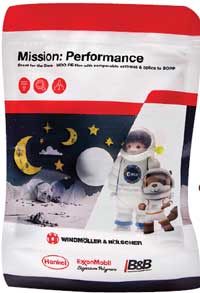
W&H’s Machine Direction Orientation (MDO) technology was used to produce an ultra-thin 25 μm PE substrate with outstanding stiffness, optical quality, and printability, comparable to conventional BOPP films.
A five-layer sealant web was formulated using ExxonMobil’s resins and laminated with Henkel’s recycling-compatible PU adhesive, creating a monomaterial PE structure designed for recyclability.
Finally, B&B converted the laminated film into high-performance stand-up pouches on its STBB 8K equipment, delivering both process efficiency and consistent package quality.
The collaboration resulted in a monomaterial PE pouch that combines high-performance stiffness, excellent optical properties, and robust sealing performance while supporting recyclability. Key benefits demonstrated include:
- Outstanding stiffness of the 25 μm MDO PE substrate, even at elevated temperatures, comparable to BOPP.
- High-quality printability and excellent optical clarity, critical for shelf appeal.
- Downgauged 90-115 μm sealant web maintaining seal strength and package integrity.
- 100% survival in 2-m bag-drop tests, confirming robust mechanical performance.
SUBSCRIBE to Get the Latest Updates from PRA Click Here»