Green news: Reju secures EUR135 mn funding for Dutch recycling plant; Röhm adds on chemical recycling at German plant
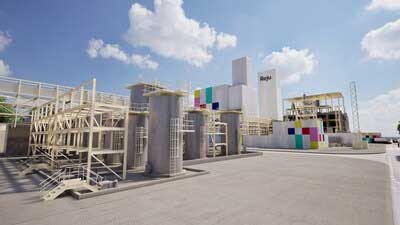
Textile-to-textile regeneration company Reju has been awarded EUR135 million in funding under the Netherlands’ Nationale Investeringsregeling Klimaatprojecten Industrie (NIKI) program. The funding will support Reju’s planned industrial-scale regeneration hub at Chemelot Industrial Park in Sittard-Geleen, Netherlands, covering both the investment phase and ongoing operations.
Patrik Frisk, CEO of Reju, said, “This award is a strong vote of confidence in our technology and our team. At Chemelot, we will deliver circular raw materials at scale, reduce emissions across textile value chains, and establish a replicable blueprint for circular textiles in Europe.”
NIKI is the Dutch government’s flagship program to accelerate large-scale industrial decarbonisation and circularity, supporting both national and European Union circular economy objectives. Reju’s project is closely aligned with these goals, expanding a textile-to-textile process that converts difficult-to-recycle, polyester-containing textiles into high-quality circular intermediates for new polyester production. By diverting residual textile fractions from landfill and incineration, Reju, aims to materially reduce the environmental impact of textile waste.
The future Regeneration Hub will process post-consumer textiles that would otherwise enter the waste stream. This regenerated output will be transformed into Reju Polyester, delivering approximately 50% lower carbon emissions compared with virgin polyester. The material will then be reintroduced into downstream supply chains, where it will be converted into yarns and fabrics ready for end-use consumer applications.
The project is expected to emphasise industrial integration, energy and resource efficiency, and fully traceable circular supply chains, maximising the displacement of virgin, fossil-based inputs.
In other news, at its Worms site in Germany, chemical firm Röhm says it is using an in-house developed technology for the first time on an industrial scale. It enables the processing and upgrading of chemically recycled methyl methacrylate (MMA). The starting material is polymethyl methacrylate (PMMA), which becomes high-quality MMA again through depolymerization.
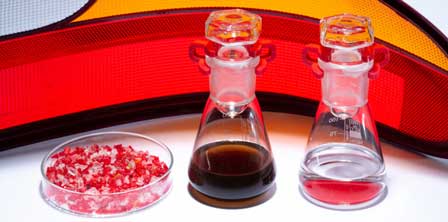
PMMA is a versatile plastic that can be found in vehicle taillights, medical devices and numerous other applications. Due to its chemical structure, the material is particularly suitable for efficient, high-quality recycling processes, achieving more than 90% yield in depolymerisation processes.
The new technology can be easily integrated into the existing MMA production in Worms. With this investment, Röhm is creating the basis for a closed and scalable material cycle. Starting summer 2027, the recycled MMA will be used for manufacturing sustainable proTerra products throughout Röhm's Verbund structure.
The scale-up of the technology to industrial scale is Röhm’s contribution to the European Recycling Alliance for PMMA, which was founded together with partners at the end of 2024. The aim of this network of companies is to significantly increase the recycling rate of end-of-life PMMA across Europe and to establish a completely closed material cycle.
The alliance partners take on various tasks: Pekutherm collects and sorts around 5,000 tons of PMMA waste throughout Europe every year. MyRemono processes these quantities into technical rMMA by means of depolymerisation. At Röhm in Worms, this technical rMMA is finally upgraded into MMA in virgin material quality.
Röhm's investment is funded and supported by the German Federal Ministry for Economic Affairs and Energy. The funding program helps industrial companies in Germany to save energy, conserve resources and reduce emissions. “
(PRA)SUBSCRIBE to Get the Latest Updates from PRA Click Here»