Middle East crisis to cut global oil/gas demand by 2050
The prolonged disruption to Middle East energy supplies could accelerate a structural shift in global energy systems, halving oil and gas import dependence by 2050 and reducing oil demand by 20% and gas demand by 10% relative to the base case. As countries prioritise energy security, demand is increasingly met through electrification, renewables, coal and nuclear, while reliance on globally traded fuels has declined, according to Wood Mackenzie.
However, this shift comes with trade-offs. Energy systems become more domestic and diversified, but also more costly, while near-term emissions rise due to increased coal use before converging with the base case over the longer term. These findings are based on a new conflict scenario from Wood Mackenzie, part of its Lens Energy Transition Scenarios, which explores how sustained geopolitical instability could reshape global energy demand, supply and investment through 2050.
The scenario assumes a major geopolitical escalation beginning in early 2026, disrupting 15–20% of global oil and LNG supply. In the near term, oil demand will fall by around 9% due to supply outages before recovering to pre-crisis levels by 2030, Wood Mackenzie noted.
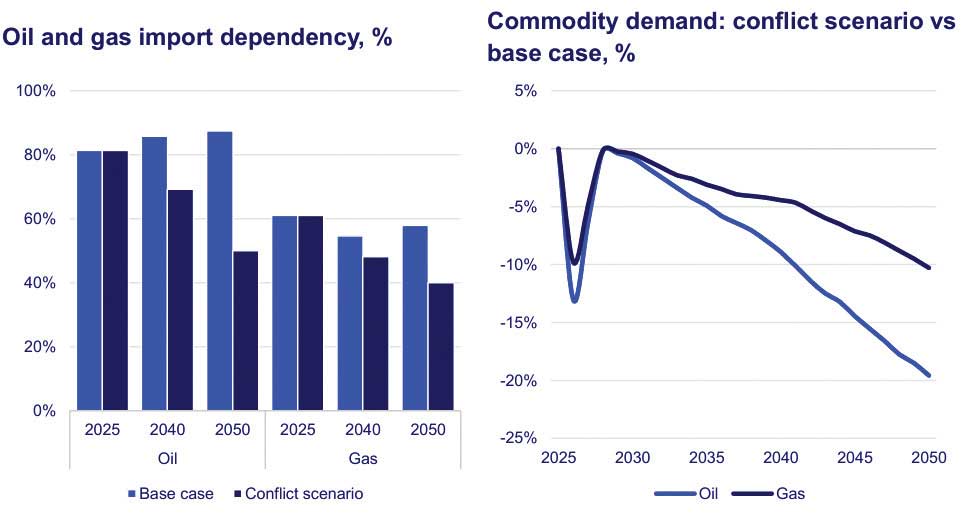
Beyond 2030, structural shifts will take hold as countries accelerate efforts to reduce reliance on imported fuels. Oil and gas demand will decline more rapidly than in the base case, as governments prioritise domestic and diversified energy systems.
Electrification and efficiency will emerge as the primary pathways to energy independence. Overall power demand remains broadly in line with the base case, as lower demand from electrolytic hydrogen production is offset by wider electrification across transport, buildings and industry. This shift will reduce reliance on imported fuels while maintaining overall energy service demand.
A rebalanced energy mix
By 2050, the global energy mix will shift significantly under the conflict scenario:
- Oil demand will fall 20% and gas 10%, while coal will rise 20% as countries diversify supply and prioritise domestic resources
- Nuclear generation will increase 40% above the base case, with both conventional and next-generation technologies scaling from the 2030s
- Renewables will continue rapid expansion, forming the backbone of domestic power systems
- Hydrogen and carbon capture adoption will decline, as policymakers favour more efficient and secure energy pathways
Coal will play a larger role in the near term as countries respond to supply shocks by maximising domestic energy sources and delaying plant retirements. Over the longer term, nuclear will expand significantly, providing stable, fuel-secure baseload power as new capacity comes online from the 2030s.
Gas-fired power and hydrogen-based abatement pathways will be scaled back as energy systems favour more secure and proven alternatives.
The shift towards energy independence comes with higher system costs, as countries move away from globally optimised supply chains towards domestic production and diversified sourcing.
Climate outcomes converge
Despite diverging pathways, cumulative emissions under the conflict scenario remain broadly aligned with Wood Mackenzie’s base case, tracking a 2.6°C warming trajectory. While emissions rise in the near term due to increased coal use, these will be offset over time by stronger electrification and nuclear deployment, thereby reflecting a trade-off between Near-Term Energy security and long-term decarbonisation, with countries ultimately relying on proven, domestically controlled technologies.
(PRA)SUBSCRIBE to Get the Latest Updates from PRA Click Here»