2026 - 2027 Exhibitions
BASF Expansions: Inaugurates non-ionic surfactant site in South Korea; Starts up plant for 3D-printed catalysts in Germany
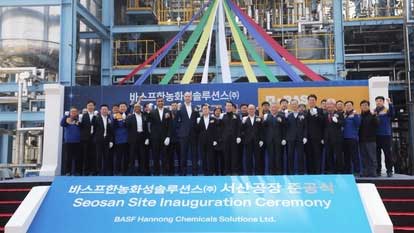
BASF Hannong Chemicals Solutions Ltd. (BHCS), the joint venture between BASF and Hannong Chemicals, recently announced the inauguration of its new non-ionic surfactant (NIS) site located in the Daesan Industrial Complex in Seosan, Chungcheongnam-do, South Korea.
Built on a site of approximately 12,234 sq m, the site is operated by BHCS, the joint venture established with a shareholding structure of 51% BASF and 49% Hannong Chemicals, and began trial operations in January 2026. With support from Chungcheongnam-do Province and the City of Seosan, a swing tank was installed to enhance production flexibility and supply reliability.
The site combines BASF’s technology and product innovation capabilities with Hannong Chemicals’ production capabilities to supply non-ionic surfactants to customers across Asia. In the future, production will be expanded to include specialty surfactants, further strengthening BASF’s global production network.
The non-ionic surfactants produced at the new facility are used in a wide range of industries, including the chemical industry, agriculture, cosmetics and personal care, as well as the polymer and polyurethane (PU) foam stabiliser industry.
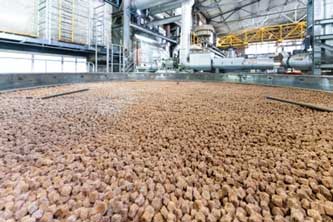
Meanwhile, in related news. BASF has started up what it says is the world’s first production plant for catalysts based on X3D technology at its Ludwigshafen site. With the commissioning of this facility, the German firm says it is scaling the additive manufacturing of catalysts to an industrial level and strengthening its leading role in innovative solutions for the chemical industry.
Utilising X3D technology, catalysts can be produced with optimally designed geometries that combine high mechanical stability with an open structure. This significantly reduces pressure drop in reactors while simultaneously increasing the catalytically active surface area. As a result, customers achieve higher reactor throughput and improved product quality at substantially lower energy consumption compared to conventional catalysts.
BASF has been supplying X3D catalysts to production plants for several internal and external customers for many years. The technology is versatile and can be applied to a broad range of catalyst materials, including precious and base metal catalysts as well as various support materials.
The new production plant in Ludwigshafen provides the foundation for making this technology more widely available and for further shortening development and market introduction timelines.
In 2025, China-based fine chemical company An Hui Jintung filled its production plant with BASF’s sulphuric acid catalysts O4-115 X3D.
“The plant started up smoothly, and plant performance has significantly improved compared to before. Production achieved a record high, generating substantial economic benefits for our company. We will continue our collaboration with BASF to promote catalyst upgrades and replacements across additional units,” said Eter Zhu, General Manager at An Hui Jintung.
“We are pleased that X3D technology already gives our customers a real competitive edge: We can supply catalysts tailored precisely to their specific chemical processes – quickly and in large quantities. At the same time, we help customers reach their goals, as our catalysts enable them to increase production performance while improving the efficiency of the raw materials they use,” said Detlef Ruff, Senior Vice President Chemical Catalysts and Adsorbents at BASF.
Subscribe to Get the Latest Updates from IMA Please click here








©2026 Injection Moulding Asia. All rights reserved.