
2026 - 2027 Exhibitions
Engel builds world’s largest injection machine
Austrian machinery maker Engel says it has built what it claims to be the biggest injection moulding machine in the world. The two-platen machine, duo 12000 US, with a clamping force of 110,000 kN was specifically developed for parts with projected areas of more than 2.5 m² and was recently commissioned at a customer ’s site.
With this, Engel adds that manufacturers can produce large-format structures in a single production step. This reduces material usage, simplifies production logistics and thereby saves time and costs. In addition, it improves the CO2 footprint over the entire product life cycle.
To enable large shot weights for large-area components, the system is equipped with two injection units operating in parallel. With screw diameters of up to 210 mm, they enable a shot volume of up to 65,000 cm³ and homogeneous filling of large projected areas.
The customer selected eight tie bars, while machines of this size are also possible with four tie bars, according to Engel.
The dimensions of the system illustrate the technical challenge: with a length of 24 m and a height of 8.4 m, it is among the largest industrial production systems in injection moulding worldwide. The total weight is 551 tonnes, the maximum mould weight 170 tonnes. In total, around 30 km of cables were installed. The total installed power is approximately 2.4 MW with a total current of 2,900 A.
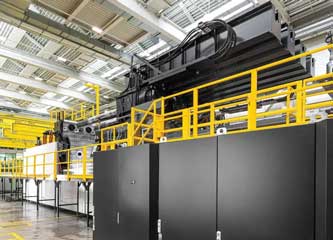
Despite these dimensions, Engel says the machine remains compact,. thanks to the modular design principle of the duo series, thereby saving valuable floor space.
In addition to the standard sizes of the duo series, several systems with clamping forces of 74,400 kN have already been installed in the market, it adds. Despite their dimensions, the large machines are characterised by exceptional precision. Through options such as injection compression moulding, the component dimensions can be defined with an accuracy of a few hundredths of a millimetre, a level of precision comparable to the thickness of a sheet of paper.
In the automotive sector, demand for such gigamoulding solutions for large structural components is increasing. Megatrends such as electromobility, autonomous driving, platform consolidation and CO2 reduction targets are driving this development. Applications such as battery housings, underbody panels or hybrid inner door structures can be rethought through the new production possibilities. The objective is to reduce the costs of components, and with functional integration, weight reduction and reduced assembly complexity are possible.
Large machines also open up new application potential in the field of technical injection moulding and Engel adds it has already successfully established machines with clamping forces of around 11,000 tonnes in the market, for logistics and infrastructure products. These include transport containers for the disposal of e-mobility batteries, large-volume infiltration boxes for rainwater management as well as water tanks with mould areas of nearly 6 sq m and shot weights of up to 109 kg.
With the duo 12000 US, Engel says the system is not only a record-holder in terms of size, but also serves as a platform for new technologies, material substitution and highly integrated component concepts for mobility, infrastructure and industry sectors. It also demonstrates the potential of gigamoulding for the industrial production of large-format structures.
Subscribe to Get the Latest Updates from IMA Please click here











©2026 Injection Moulding Asia. All rights reserved.